


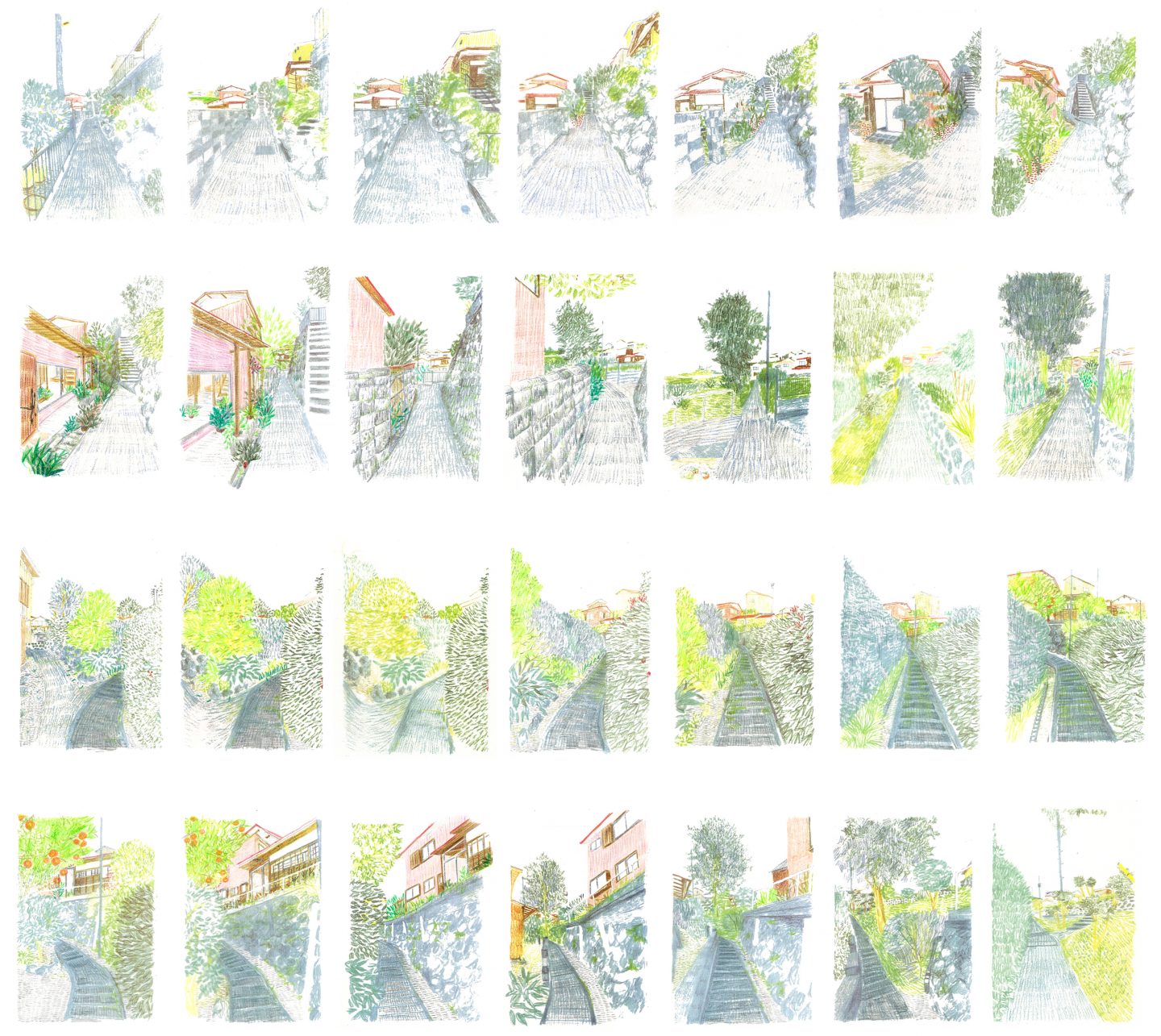
敷地に面する2本の背戸道からの風景を連続的に切り取り、5歩1枚のペースでかきおこしてみました。
この建築を目的地とする視点ではなく、横目で意識しながらただ通りすぎる視点です。 石垣もブロック塀も、生垣も雑草も同じように、優劣つけずにただありのままを描き、設計で変える部分を修正ペンで消してはまた描く、を繰り返し行いました。建築をどうつくるかよりも、風景の中にどうとかしていくことができるかを検討しています。
この「風景展開図」から生まれた提案は、ブロック塀を半分解体して建物の腹部分に新しい入口をつくること、外壁面を半間交代させ、道のくびれに小さなポケットを生むこと、敷地の高低差を微分して室内まで展開すること、擁壁のもつ影の質感を増幅させる素材のざらつきなど、絵画的に発見した背戸道の経験を、建築に引き込むようなものとなりました。
We continuously extracted views from two back alleys facing the site and redrew them in sequence on a five-panel spread.
Rather than treating the architecture as a destination, this study adopts the viewpoint of someone simply passing through—aware of the architecture only peripherally. Stone walls, block fences, raw earth, and wild grasses were all drawn without hierarchy, as they exist. Elements altered through design were erased with correction fluid and redrawn, repeating this process over and over. Rather than focusing on how to construct the architecture itself, we explored how architecture might be positioned within the landscape.
The proposals that emerged from this “landscape elevation drawing” include partially dismantling a block fence to create a new entrance at the rear of the building; replacing sections of the exterior wall to form small pockets along the winding street; subtly extending changes in site elevation into the interior; and amplifying the coarse texture of materials to deepen the quality of shadows cast by fences. In this way, experiences discovered through the drawn observation of the back alley were translated into architectural form.