



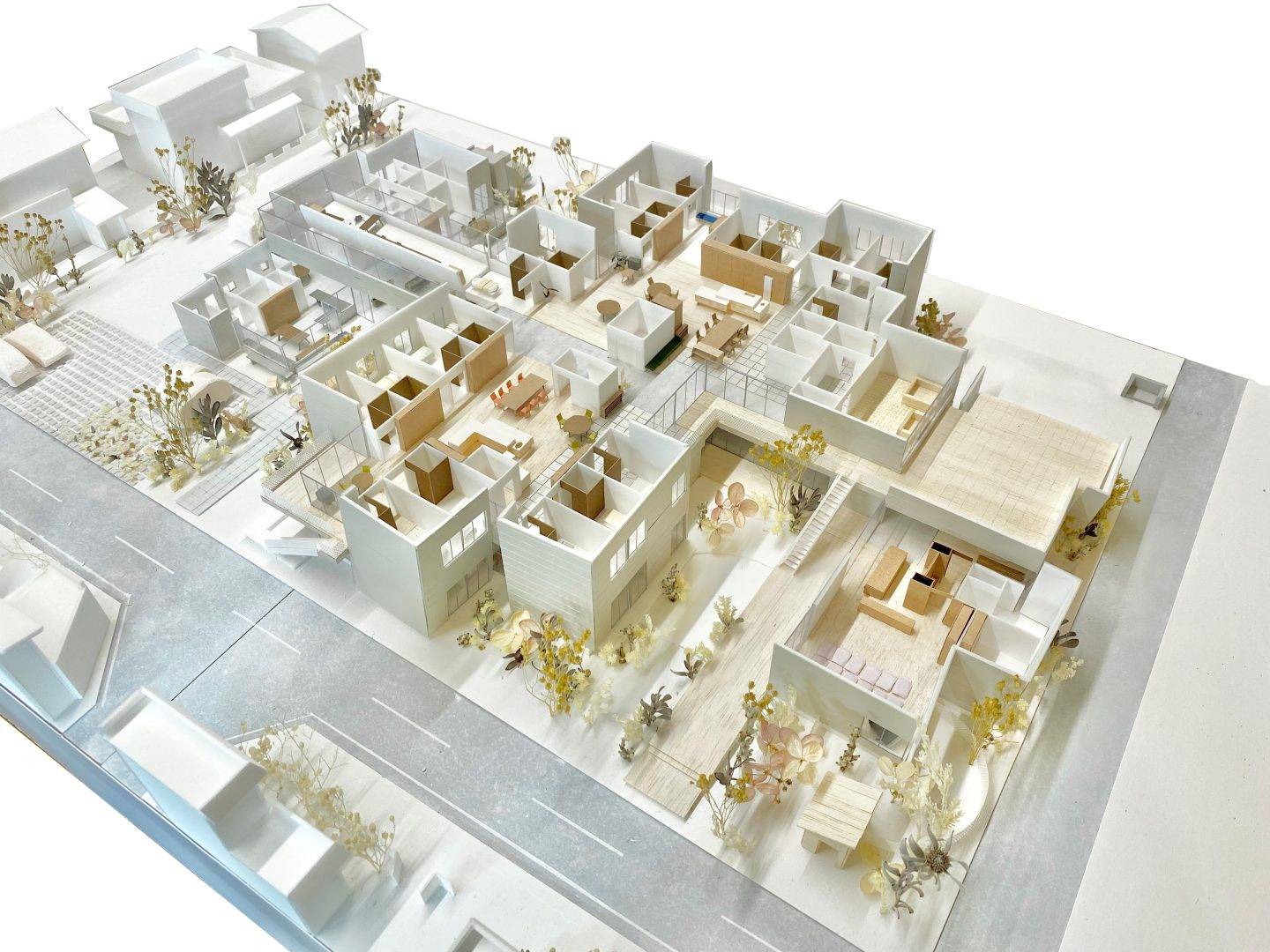
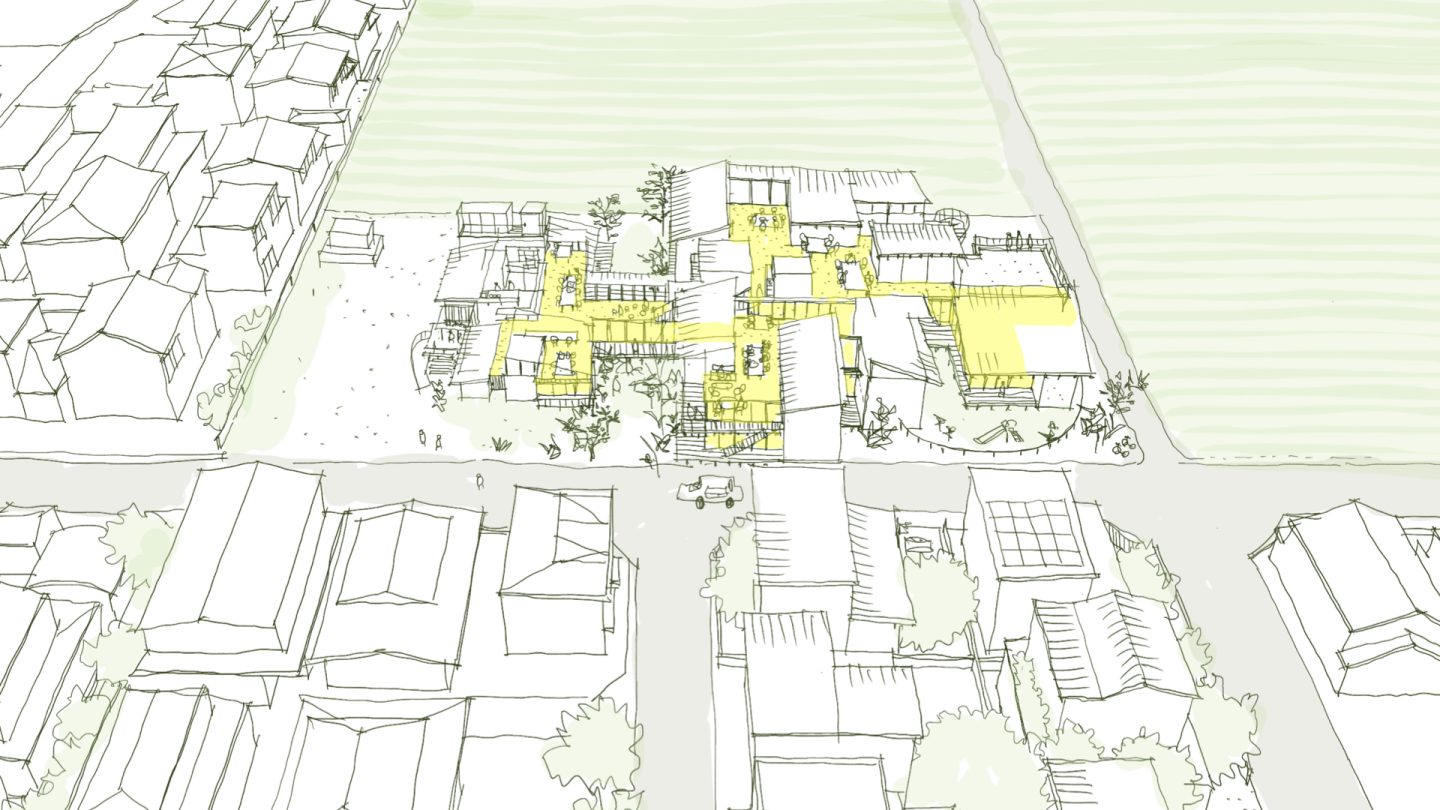
高齢者、障がいがある方の就労支援、保育園も含み、多種多様な年齢・身体の方の時間を、ぎゅっと詰め込んだ建築である。さまざまな身体と心が居合わせ生活を共にしていくこの場所では、福祉の単なるサービスの場ではなく、互いに支え合い学び合う場として捉え、集まり方、活動の重なり方などの分布や密度、関係性から建築を考えることになった。
微地形の上に集合集落を築き暮らしてきた地域のあり方に習い、生活の場として道を背骨として持ち、枝としてそれぞれの福祉プログラムを配置した。ユニット同士が道を介して向かい合い、小さな庭をいくつも共有する集合体である。さらに各ユニットを2〜3部屋単位の小さなボリュームに分解し、「耐震帯」として整理することで、簡単な内装改修によりルームのサイズや向きを変更できるよう計画した。将来的な福祉の制度変更や地域の需要の変化などにも、その都度建築が柔軟に場を整えられるように、変化できる構造システムを下地としている。要介護度4〜5の入居者は、自分自身で動けない方が多い。そこで、ケアとして起こっている日々の出来事、多様な登場人物たちが織りなす生活のサーキュレーションを「動く環境」として捉え、その動きに隣合うように日々の居場所を重ねて設計した。毎日の食事やシーツ交換などの福祉ケア、ごみ収集などのインフラ、小学生の登下校などの日々の出来事、季節の移ろいなど、いろんな出来事のサイクル動線を、道や庭、居場所に重ね合わせ、誰もがまちの日々に参加し、関係性が築くきっかけを持とうと思えば持てるような状況をつくろうと試みた。また、施設運営のプロたちにより既に蓄えられてきた大量のトライアンドエラーを、何重にもヒアリングして設計を進めた。特養の個室は死亡率が高い部屋があるという。そこで、目の届きやすさや自然が見えることを重視し、すべての居室を生活共同室から廊下を挟まず直接アクセスできるようにし、すべての窓から季節が伺える庭が眺められるように計画した。また、ユニット同士を向かい合わせに配置し、ケアの視線や動線が自然に行き交いする構成とし、日々の見守りを多重に行い夜勤者の人数編成を省力化するなど、ひと、もの、ことの流れをケアのノウハウや制度からも空間に再構成した。ほんの一瞬でもすぐに事故に発生してしまう福祉の現場の危機感と、豊かな生活の時間を築く場としてのバランス、また、ひとりで泣いたりできるような豊かな死角となる逃げ場の必要性など、この対話の場で、ふと発見される感覚的な言葉を何よりも信頼して設計を進めた。ひと、もの、出来事を空間の上に固定していくためではなく、その時おり折にそれぞれが即興的に居心地がよいと思える距離や関係性を築く事ができるような、曖昧で寛容な集合を支える環境を目指した。
This project aims to bring together a wide range of people and activities, including employment support for elderly individuals and people with disabilities, together with a nursery school. In this constellation, where diverse bodies and minds coexist and live together, the architecture is conceived not as a place for welfare services alone, but as a space for mutual support and shared learning. Architecture is considered through relationships, focusing on the distribution and density of how people gather and how activities overlap.
Drawing inspiration from the way local communities have historically formed clustered settlements in response to subtle variations in the terrain, the building is organized as a living environment structured around a road as its backbone, with individual welfare programs branching off from it. Units housing the various programs face one another across this road and share multiple small gardens, forming a clustered collective.
Each unit is further subdivided into small sections of two to three rooms, organized as structurally defined zones. This allows room sizes and orientations to be reconfigured through relatively simple interior modifications. Anticipating future changes in welfare systems and shifts in local needs, the project establishes a flexible structural framework that enables the architecture to adapt and reorganize its spaces over time. Many residents requiring high levels of care (care levels 4–5) are unable to move independently.
In response, the daily events that unfold through the care of residents, together with the circulation of everyday life shaped by a diverse cast of people, are understood as a “moving environment.” The design layers everyday places alongside these movements. Cycles of daily care such as meals and linen changes, infrastructure operations like waste collection, everyday events such as children commuting to and from school, and the rhythms of seasonal change are overlaid onto roads, gardens, and places to stay. Through this layering, the project seeks to create conditions in which anyone can participate in the everyday life of the town and, if they choose, find opportunities to form relationships.
In addition, the design process was informed by repeated and in-depth interviews with facility staff, drawing on the extensive accumulation of trial and error embedded in their professional practice. It is known that within special nursing homes, certain private rooms tend to be associated with higher mortality rates. In response, the project prioritizes ease of supervision and access to nature by allowing all private rooms to be accessed directly from shared living spaces without intervening corridors, and by ensuring that every room looks out onto a garden where the changing seasons can be perceived.
Units are arranged to face one another so that lines of sight and care circulation naturally intersect. This configuration enables layered systems of daily observation while reducing the staffing burden during night shifts. In this way, the flows of people, objects, and events are spatially restructured, informed by care expertise and institutional frameworks.
In welfare environments, where even a brief moment can lead to an accident, the design process sought to balance this constant sense of risk with the creation of time and space for a rich everyday life. It also recognizes the need for places of retreat, spaces of refuge where one can be alone, even to cry. Throughout this process, the design was guided above all by the intuitive, sensory words that emerged unexpectedly through dialogue.
Rather than fixing people, objects, and events rigidly into space, the project aims to support an environment that sustains an open and tolerant collective, allowing individuals, moment by moment, to improvisationally form distances and relationships that feel comfortable to them.
- 設計|Design
-
建築|Architecture冨永美保・市川竜吾・林恭正・加藤大稀・重野雄大・牧迫俊希・畠山亜美・柳沢優志/tomito architecture
川見拓也/川見拓也建築設計事務所
Miho Tominaga, Ryugo Ichikawa, Yasumasa Hayashi, Daiki Kato, Yudai Shigeno, Toshiki Makisako, Ami Hatakeyama, Yūshi Yanagisawa / tomito architecture
Takuya Kawami / Takuya Kawami Architects -
構造|Structure大野博史・藤田竜平/オーノJAPAN
Hirofumi Ono, Ryuhei Fujita / ONO JAPAN -
設備|MEP山下直久・上野詩織・松井知行/コモド設備計画
Naohisa Yamashita, Shiori Ueno, Tomoyuki Matsui / Comodo Building Services Engineering -
家具|Furniture安川流加
Ruka Yasukawa -
ファブリック|Fabric山本紀代彦・森永一有/fabricscape
Kiyohiko Yamamoto, Kazuari Morinaga / fabricscape - 工事
-
監理|Supervision冨永美保・柳沢優志/tomito architecture
川見拓也/川見拓也建築設計事務所
Miho Tominaga, Yūshi Yanagisawa / tomito architecture
Takuya Kawami / Takuya Kawami Architects
-
建築|Architecture八鍬英幸・鈴木英信・皆川昭明・鈴木祥晃/ジャパンビルド株式会社
Hideyuki Yakuwa, Hidenobu Suzuki, Teruaki Minagawa, Yoshiaki Suzuki / JAPAN BUILD Co., Ltd. -
電気|Electrical Eng.春山節郎・信太健児/有限会社協電社
Setsuro Haruyama, Kenji Nobuta / Kyodensha Co., Ltd. -
機械|Mechanical Design稲葉秀和・井上葵裕・渡辺正人・猪野和洋/株式会社内藤工業所
Hidekazu Inaba, Kihiro Inoue, Masato Watanabe, Kazuhiro Ino / Naito Kogyo Co., Ltd. - 写真|Photo
-
新建築社写真部
Shinkenchiku Photography Department -
tomito architecture
- 概要|Overview
-
所在地|Location宮城県仙台市若林区
Wakabayashi Ward, Sendai City, Miyagi Prefecture, Japan -
主な用途|Primary Use地域密着型ユニット型特別養護老人ホーム+看護小規模多機能型居宅介護+保育所
Community-Based, Unit-Type Special Nursing Home + Small-Scale Multifunctional In-Home Care with Nursing + Nursery School -
構造|Structure鉄骨造2階建
2-Story Steel-Framed Structure -
敷地面積|Site Area2981.36㎡
-
建築面積|Building Area1281.25㎡
-
延床面積|Total Floor Area1969.19㎡